Everything your ward coordinates.
Numbered is the day-to-day layer — the program, the calendar, the speakers, the to-dos, and the contact list underneath it all. Not the system of record; the place your ward actually gets coordinated.
Remember every member.
Numbered is built on your own ward contact list — names and contact info you bring in, plus the notes you add yourself. That list isn't a static directory; it's the engine the rest of the app runs on.
- Activity level — your own honest read (high / medium / low / do-not-contact), not a status pulled from a record.
- Notes & interviews — private to the leader who wrote them.
- To-dos, linked to the member they're about.
- Custom fields for whatever your ward actually tracks.
Ward council, on the same page.
The bishopric shares a working view. Each leader's private observations stay their own.
Shared with the council
So nobody's working from a stale copy.
- The sacrament program & speaker plan
- The callings tracker
- Shared to-dos & assignments
- The interview schedule
Private to you
Yours alone — even from the rest of the bishopric.
- Your personal notes
- Your interview notes
- Your pastoral observations
- Never inherited by the next leader
Sacrament meeting, planned together.
Build the whole program from your ward list and let the right people own their part — then it's on every phone the moment it's saved.
- Theme, speakers, and prayers straight from the directory, in any order.
- Speakers stay hidden until you mark them confirmed.
- Give the music coordinator limited access to set hymns — nothing else.
- A clean conducting script, a recent archive, and hymn numbers that link to the Church's hymn page.
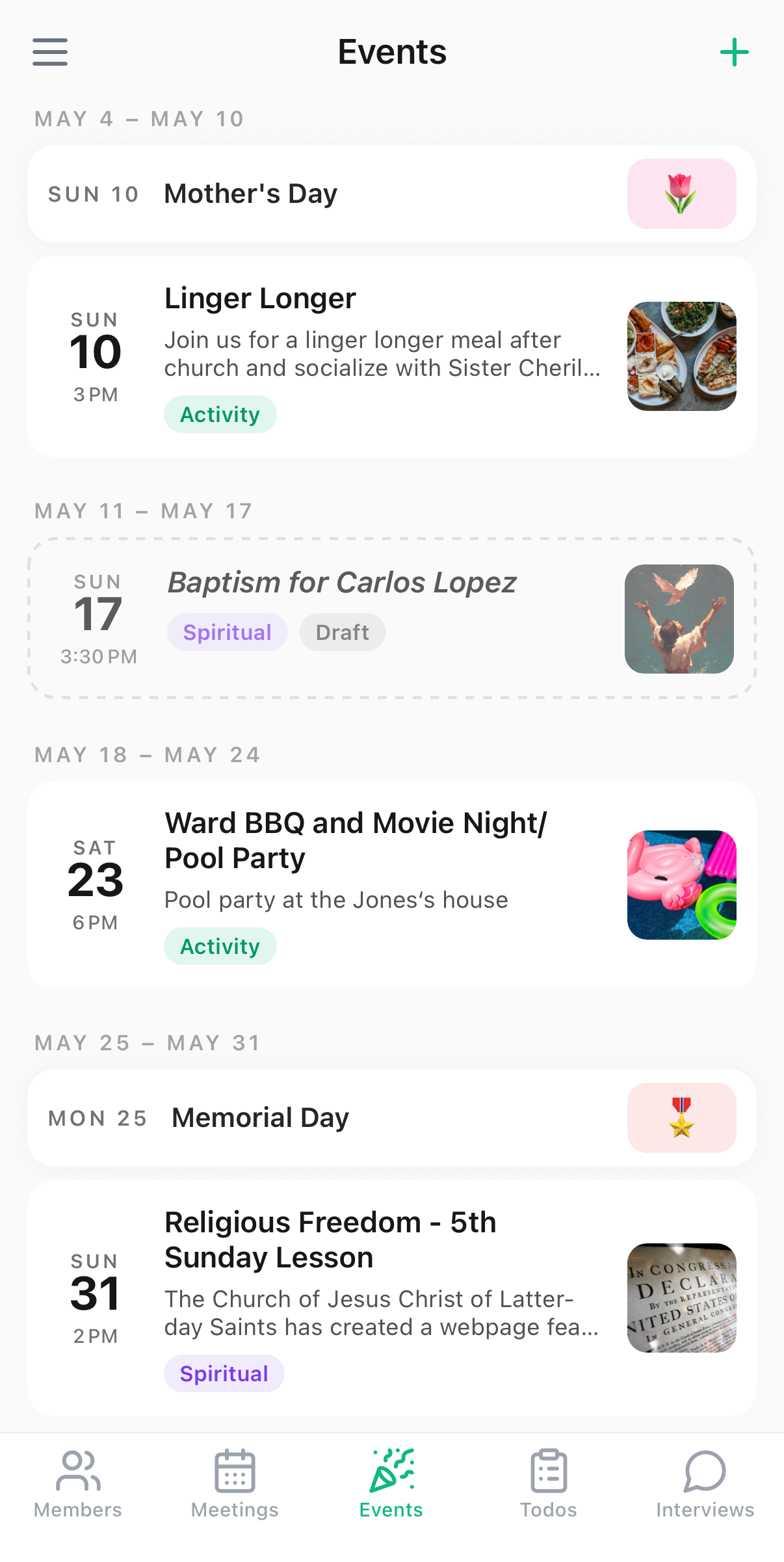
Events, announcements, schedule exceptions.
Publish what's happening, and let people's phones do the reminding. Then add the photos and the calendar quietly becomes your ward's history.
- Activities, youth nights, service projects, and spiritual events.
- Up to a dozen photos per event — a cover plus a swipeable gallery.
- Schedule exceptions — stake conference, a moved meeting — push to every phone in the ward.
Power tools, quietly available.
Calling tracker
From considering to sustained on a board the bishopric shares — record outcome, set-apart, and whether it's in LCR. The record stays in LCR; this is the messy middle.
Interview scheduling
Publish the bishopric's open slots, see who needs scheduling, and book against the right interviewer with a reason and a length.
Reports
Who's moving in or out soon, where members go to school — the summaries you'd otherwise build by hand.
Map view
Flip the directory to a map and see where members live — for planning visits and ministering routes.
Search, filter, sort
Filter the whole list by activity, status, calling, or focus members; sort by name or recency. Your filters are remembered.
Compliance reminders In design
The recurring duties that are easy to forget — financial statement, quarterly report, audit — dropped onto the right to-do list automatically.
For every ward member.
The useful half — no leader tools, no clutter.
This Sunday's program
Theme, speakers, prayers, and hymns the moment it's published. Hymn numbers open to the Church's hymn page.
A reminder before it starts
A gentle push ten minutes before sacrament meeting, with today's program in your pocket as you sit down.
Past Sundays, kept
Miss who spoke last week, or want a hymn from a month ago? Recent program history is right there to scroll.
One ward calendar
Activities, youth nights, service projects, and schedule exceptions — with photos from the ones that already happened.
A little about everyone
Members add a sentence or two — faces and friendly words, the kind of thing you'd pick up in a hallway chat. No phone-number lists.
The ward basics
Meeting times, who the bishopric is, where the building is — the stuff a new move-in always has to ask three people to find out.
It works with LCR — it doesn't copy it.
Numbered handles the coordination the Church's tools leave to spreadsheets and group texts. The membership record never leaves LCR.
Imports only contacts
The single thing Numbered pulls from LCR is contact information — names and the details you choose to export. Never callings, ordinance dates, temple-recommend status, mission history, or ministering assignments.
Fills the gaps
Sacrament planning, the calling pipeline, interview scheduling, and private member notes — the day-to-day work LCR and Member Tools were never built to do.
Sends you back to LCR
Numbered can't write to LCR. When a calling is sustained, it nudges you to record it there — the official record stays the official record.
Why importing contacts is allowed
Contact information is meant to be shared and used — the Member Tools app has a first-class "export contacts" feature for exactly that. Contact info is the only Church-originated data Numbered ever stores; the sensitive parts of the record — callings, ordinances, temple-recommend status, ministering assignments — stay in LCR, untouched. Export your ward's contacts once (LCR lets you grab them all at once), paste them in, and the rest of Numbered runs on top.
Who sees what.
Every piece of data has a clear home — and the official record was never one of them.